Primary Source 7

Fossil

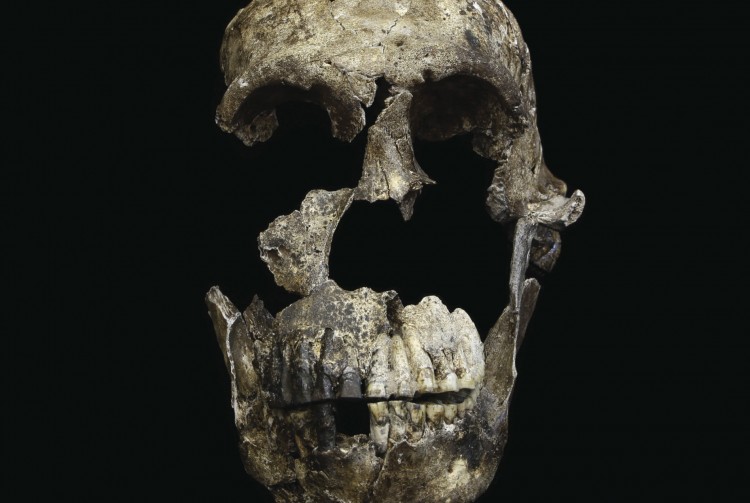
This skull, part of a skeleton that scientists have named Neo, was found in the Lesedi Chamber of the Rising Star Cave system in South Africa. Most of the bones in the middle of the face are intact, unlike another skull found in a nearby chamber of the cave system.

This skull is a part of the skeleton scientists have named Neo who was found in the Lesedi Chamber of the Rising Star Cave System in South Africa. This species of human is known as Homo Naledi. The remains found in the cave are believed by scientists to be between 236,000 and 335,000 years old. This species of humans could have coexisted at a time when Homo sapiens were starting to arrive. The skeleton found in this chamber is one of the most complete skeletons of an early human found to date. This source connects to our class with the human origins part of our class. In class we had talked about early Hominids and other kinds of human species that existed before modern humans.

Primary Source 6

Shackles

These were ankle shackles that were used to restrain people aboard ships in the middle passage. The middle passage was a traumatic experience for slaves. The middle passage and slavery included forced labor upon individuals. Slaves were packed tightly because all of the ships were overcrowded. the mortality rate was high, about 22.6% before 1700. There were revolts that occurred regularly. This source connects to the slavery segment of our class. The shackles would be used on slaves to keep them from fighting back or getting away. They were not made for comfort, it was the beginning of of how slaves would be tortured.

Primary Source 5

Origins of the Buganda People

A community in pre-colonial Buganda at war. Buganda was an arena of civil wars fueled by political ambitions by religious sects and foreigners. They had a lack of written history with makes it hard to distinguish different dates in their history. This kingdom expanded for a number of reasons. It expanded with the decline of the Bunyoro Kingdom, it had an effected and civilized centralized system of government. Their population began to expand and they had good trade with he East African coast. This image connects to the East Africa segment of our class when we discuss the Buganda Kingdom. 

The Coming of Judar Pasha

The Coming of Judar Pasha


  • Ould-Kirinfil was a servant to the prince of Songhay. He managed to escape from his confinement and succeeded in reaching the red city of Marrackech.
  • Ould-Kirinfil stayed in Marrackech and wrote the Moroccan sovereign a letter informing him of his arrival and encouraging Ahmad al-Mansur to take over the country of Songhay and to rescue it from the hands of its master.
  • Ahmad al-Mansur writes in a letter demanding that the salt mine of Taghaza be given over to him, a mine that he had to right to possess due to his efforts
  • When he returned to Marrackech, the snow fall almost caused his death. A grat number of his people lost hands or feet due to the effects of the cold.
  • Askiya Ishaq did not consent to abandon the mine, Ahmad decided to send out an army to the Sudan, Judar Pasha was placed in command of this expedition.
  • Judar safely led his army to the Niger and showed success of leadership
  • When the armies met the battle was to begin on Tuesday, the seventeenth day of the month, several notable people were perished, as well as several foot soldiers died.
  • Judar and his army continued as far as Kagho. Khatib Mahmud went to the Moroccans and welcomed them, showing them generous hospitality. He had conferences and meetings with Judar, during which he was treated with respect.
  • Judar entered the palace of Askiya Ishaq and discovered it to be miserable, having a lack of wealth
  • When Moroccan army entered the Sudan and found one of the countries that God favored the most with wealth and fertility.
  • There was violence and troubles that continued until the moment the dynasty of Songhay drew to its end and its empire ceased to exist.
  • Moral corruption began to take place including adultery
  • Because of these abominations, God took revenge by causing the victorious Moroccan army to attack the Songhay, it came from a far-off country, and amid terrible suffering
  • Judar was to search homes for weapons, then announced that all inhabitants would have to pledge allegiance to Sultan Ahmad al-Mansur, which is what he wanted
  • There were several groups of people taken prisoner
  • One of the groups were massacred, a single individual, Muhammad ibn al-Amin Kanu, was able to escape
  • The troops of pasha pillaged all they could find and stripped men and women naked to search them
  • The troops abused women and took them as prisoners where they would remain for six months
  • Pasha wasted all the wealth he received
  • He gave generously to his soliders, but sent nothing to Ahmad al-Mansur except 100,000 pieces of gold.

Primary Source 4

Image from Ancient Egypt

Banquet scene

This is a wall painting from the tomb of a nobleman named Nebamun. His tomb was built around 1400 B.C. near the city of Thebes. This image illustrates when the nobleman and his wife would have guests over for a banquet. Their guests would be offered cones of perfumes wax and lotus flowers by servant girls. They would eat the best meats, cakes, wines, figs and dates. The guests would be entertained by music and dancing girls. The the conclusion of the night the two would say goodbye to their guests and go to bed. The image relates to the Northeastern Africa segment of our class. The image comes from Egyptian tombs about Egyptian life.

Primary Source 3

Aksumite Coin

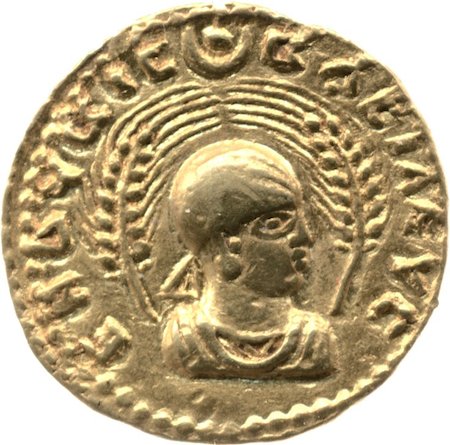
Craftsmen in the Aksum Kingdom started using special techniques in gilding to enhance the appearance and probably the value of gold coins. The gold coin shows the head and shoulders of King Endubis facing right, wearing head cloth with rays at forehead and triangular ribbon behind, framed by two wheat stalks. There is a disc and crescent on the top. The gold coins were often inscribed in Greek because they were usually to be used for exports. Silver and copper coins were inscribed in Aksumite. These coins were useful in the Aksum empire because their they were good with trade which made the Kingdom prosperous. This source connects to the Northeastern Africa segment of our class, focusing on the Aksum Kingdom.

Primary Source 2

Primary Source 2

Crown of Nubian King

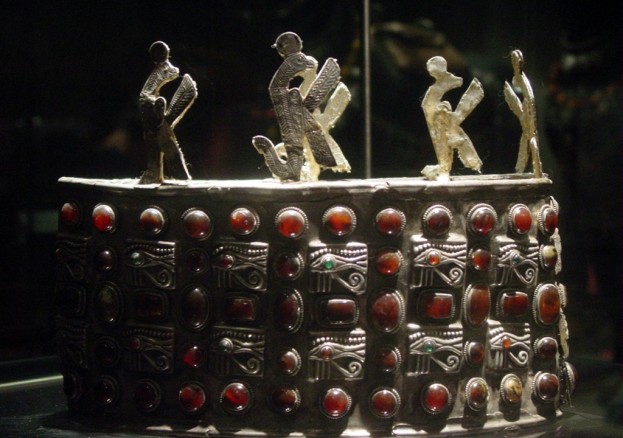
This crown belonged to a Nubian King who ruled between the collapse of the Meroitic dynasty in 350 AD and the founding of the Christian Kingdom in 600 AD. It was found in tomb 118 in Ballana in lower Nubia by a British Eygptologist. This source connects to the Northeastern African segment of our class, focusing on Nubia. Egypt colonized Nubia because of its resources like timber, gold, and copper. Also human resources that would be utilized for military purposes. Nubia was located along the Nile River. Crowns like these would be buried in the tomb with the King when they pass.

Primary Source 1

Primary Source 1

Nefertiti Bust

Nofretete Neues Museum.jpg

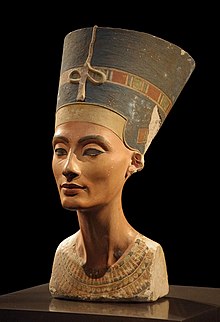
Nefertiti was an Egyptian queen married to the Egyptian Pharoah Akhenaten. The two of them ruled during the wealthiest period in Ancient Egypt history. Some scholars believe that Nefertiti ruled briefly under the name Neferneferuaten after her husbands death. Her reign was marked by the fall of Amarna and the relocation of the capital back to Thebes. Her bust, pictured above, is one of the most copied images of Ancient Egypt. The bust is believed to have been crafted in 1345 B.C. This source connects to the Northeastern Africa segment of our class. Nefertiti and her husband would have been alive and ruled during the the New Kingdom in Ancient Africa.

Concubine

The Concubine
The village of Omokachi and its surrounding villages are very close to each other, whether physically or emotionally. The inhabitants of these villages show great respect and love for one another, even if the individuals are not related by blood, they are always there for one another. Omokachi was a small village comprising of eleven family groups, because of this they had close relations with their neighbors. Worshippers from two villages would meet and offer sacrifices to establish goodwill and ensure no evil would cross from one village to the other. (pg. 14) When life brings great sorrow or trouble to the members of the village, their neighbors are quick to be by their side to aid them in any possible. This sense of community is what helped these villages thrive.
When a member of the village has been harmed, all neighbors and relatives are quick to be there for them. When Emenike came back from a fight with Madume and he was badly hurt, his brother Nnadi, and his wife Ihuoma, rushed to his side to help him, and soon the rest of the village would be aware of his injuries (pg. 3). After a confrontation with several men from the village, Mudame is injured when a snake spits poison into his eyes leaving him in pain and unable to see. Despite the prior confrontation, the men rush to get help for Mudame. (pg. 70) When Ekwueme is suffering numerous illnesses from the love potion, his parents care for him with each one, and they continue to check in on him and know when he seemed to be off from his usual personality (ch. 24). The sense of community helped the Omokachi village thrive. The whole village lived as a family and when another member of the family was in need, there was an army of people there to help them. No one wanted to see another member of their village suffer, and it showed by the actions that were represented.
When a member of the village was in need of help, they could always count on their neighbors and family members. After the fight between Emenike and Madume, Emenike’s wife, Ihuoma, stays with Emenike the whole time caring for him and preparing his food. A steady stream of visitors would come daily to be there for him as well. (pg. 7) When Emenike dies, Ihuoma is distraught and cannot seem to do anything but cry. Even though it seems like Madume is to blame, Wolu, his wife, goes to console Ihuoma even if it seems weird due to the fight between their two husbands. (pg. 20) Regardless of the situation the two women were put in because of their husbands, the two women were there for each other for their husband’s untimely death. Ihuoma was in need of a lot of help and consoling after her husband died, Ekwueme and Nnadi help her a lot. Ekwueme comes to comfort her by distracting her by having conversations with her about things like wrestling and even makes a song for Emenike’s honor (pg. 22-24). Nnadi and Ekwueme also work on Ihuoma’s leaking roof before raining season starts to prevent her from having to deal with flooding (pg. 42). Since Ihouma is the only women living in her compound, Nnadi is always watching out to make sure she is safe. When Ekwueme and his father, Wigwe, stop by to see Ihuoma late at night, Nnadi came over to make sure everything was okay and that she was safe. (pg. 112) After a year of Emenike’s death, Ihuoma has to begin the preparations for his second burial rights. Her neighbors and family help by distracting her to get her mind off of it, they help cook food and fetch water. And on the day of the ceremony a lot of people from her village and other villages come to honor Emenike. (pg. 31-35) When Ekwueme has gone mad from the love potion and runs away, the whole village gets together to search for him. Then, when Ekwueme is in a tree and the only person that will get him out is Ihuoma, she comes. She also pretends to want to marry him when it is the only things that will make him take the antidote for the potion to make him better. (pg 180-185) Despite differences or personal problems, the individuals living in the village were always there to help their neighbors and family members.
The people living in Omokachi always showed deep love and respect for one another. They lived like a family and were always there to help when someone needed it. Whether it was emotional pain or physical pain, there was always someone rushing to help. No one was ever alone and that helped the village thrive. Through great sorrow, loss, and troubles, the people of the village acted as a family and never left someone to deal with things alone.

Work Cited
Amadi, Elechi. The Concubine. Waveland Press, Inc., 2017.
Design a site like this with WordPress.com
Get started