Be yourself; Everyone else is already taken.
— Oscar Wilde.
This is the first post on my new blog. I’m just getting this new blog going, so stay tuned for more. Subscribe below to get notified when I post new updates.
Be yourself; Everyone else is already taken.
— Oscar Wilde.
This is the first post on my new blog. I’m just getting this new blog going, so stay tuned for more. Subscribe below to get notified when I post new updates.
Throughout this semester there has been a lot of information given and absorbed about pre-colonial Africa and African origins before 1800. We have explored different ways of learning about pre-colonial Africa by reading books, analyzing different types of primary sources, watching different types of films, and taking notes in class.
The different primary sources that we had to looked helped us explore more of African history. For example, the bust of Nefertiti gives information on women in Ancient Egypt, especially this woman who ruled a kingdom for some time after her husbands death. The other primary sources that we looked up helped us learn more about African history that we did not get to learn about in class. Or, it expanded on the knowledge we learned in class. For example, on this scrapbook there is an image of the Buganda people, we learned about them in class, but after picking this image, even more was uncovered about their origins and ways of life.
The primary source documents read in class also expanded on the information that was being taught in class. The “Kingdom of Ghana” document gave further insight on what is was like in the Kingdom of Ghana, and how the king of Ghana ran his kingdom.
One of my favorite parts of the scrapbook and of the class was the 1619 podcasts. It was very interesting listening to people talk about slavery and its effects, especially from people who had their own stories to tell. These episodes touched on subjects like medical attention given to freed slaves in the south, African music, and President Lincoln and his participation in slavery. I liked these podcasts because it taught things about slavery and after the Emancipation Proclamation that is not usually taught in regular history classrooms. There were a lot of new things that I learned from these podcasts. One thing I learned was that Lincoln actually wanted freed slaves to be shipped back to Africa and not stay in the United States. He thought that they would be troublesome and that was shocking to learn about from someone that we learned about as wanting slaves to be freed. Another interesting fact was that medical supples and medical attention was very limited in the south and the government did not want to see it progress in the South.
Another aspect of the scrapbook that makes it useful is the analysis of the books that were written in class. “The concubine”, “Daughters of Isis”, and “Sundiata” provided more information that expanded on what was talked about in class. What makes this scrapbook, and other scrapbooks from other students in the class, useful is that not one wrote about the same thing when it came to these books. Different themes from these books were explored and talked about to give a better understanding of what is was like in pre-colonial Africa, in different areas in Africa. The book I found most interesting was “The Concubine.” I liked that this book told a story as well as gave information about what life was like for individuals living in African villages. It gave information on how religion, personally relationships, and morals fit into the lives of Africans.
Overall, this scrapbook is an expansion on what was learned during HIS 321. It focuses on human origins of Africans that is not talked about in high school or other history classes here. This scrapbook also holds information that was not talked about in class that could help the reader gain a better understanding of pre-colonial life in Africa.
1619 Episode 2What Does It Mean To Be Human?
Daughters Of Isis 1619 Episode 4
Kingdom of Ghana, Primary Source
Primary Source 1Primary Source 2
The film “Slavery by Another Name” had different interesting elements to it. The film talks about how even after the Emancipation Proclamation and all slaves were freed from slavery, they were not actually free. One way that slavery continued for black citizens was the use of jails and being arrested. There became stricter laws and regulations that made it easier for someone to be prosecuted. For example, it was made illegal for a farmer to be walking alongside rail road tracks. Also, once slaves were freed from slavery, the amount of white citizens in jails went down. There was only about 10% of whites in jail, when it is known that whites were still committing crimes. When African Americans are arrested for minor crimes that have been made felonies, they still end up locked up and chained up like when they were slaves. This new system was known as convict leasing. It was figured out that prisoners can be used to make a profit. These prisoners were being worked as laborers in mines and factories. The freed slaves, now prisoners were still being put to extreme labor work like when they had been enslaved.
Battle of Ulundi
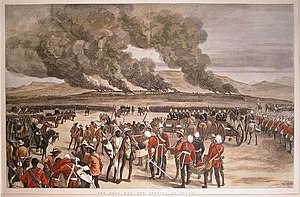
The Battle of Ulundi was the last major battle of the Anglo-Zulu War. This battle took place at the capital of Zulu in Ulundi. The British army was successful as taking down the military power of the Zulu kingdom. The British defeated the main Zulu army and immediately afterwards captured the capital of Zululan.
Battle of Isandlwana

The Battle of Isandlwana was the first major encounter in the Anglo-Zulu War between the British Empire and the Zulu Kingdom. The British army were equipped with riffles and guns, meanwhile the Zulu’s had spears and cow-hide shields. At the end of the battle the Zulu kingdom emerged victorious.
Battle of Mhlatuze River

The Battle of Mhlatuze River was between Zulu and Ndwandwe tribes in 1820 following the Zulu Civil War. Led by Shaka, the Zulu people prevailed. Same as the battle of Gqokli Hill, Zulu’s great strategy and tacts led him and his people to victory. He waited until half of the enemy was across the river and then he attacked when they were split up.
Battle of Gqokli Hill

This was to be Shaka’s first major battle against the dominant power in southeastern Africa (what would eventually become kwaZulu Natal), the Ndwandwe Paramountcy, led by nKosi (king Zwide). Even though Shaka was significantly outnumbered, his smart strategy and tactics won the battle for Shaka. His strategies also saved his people from being exterminated.
Healing People
An interesting aspect of the Great Lakes Bantu speaking people is their healing power and abilities. Great Lakes Bantu speakers have built theories on power and health in their region. The challenges faced when settling new lands, and having to rely on new sources of food and technologies drove the development of healing practices among the Great Lakes. The people of the Great Lakes knew that health and prosperity went hand in hand. The Bantu speaking people of the Great Lakes honor the gift of being able to heal very seriously and they honor those with healing abilities as well. The healers that existed during this time not only healed someone physically but it was up to them to maintain or restore the social balance of the region or homestead.
There are a few different types of doctors or healers in the Great Lakes region. There are ‘diviner-doctors’, these doctors possess a variety of powers, among these powers they have the power of healing. There are also different sorts of healers with specific areas that they heal, whether it is the body or the environment. Some healers had the ability to bring forth rain to help with the crops and the other agriculture. The healers in this region were not only responsible for the healing of people, but they could heal the environment and the resources they used. If there was a dry spell and certain crops were not going to survive, the healer with that specific power and ability could bring rain to the land and keep the crop growing. This went along with maintaining the social balance of the region. If one homestead of the region was short or crops or resources they would not be able to contribute to other homesteads in the Great Lakes. The healing of crops was also extended to the healing of the rivers if there was a shortage of fish, as well as healing the forests if there was not an abundance of animals that could be used for food and shelter. The people of the Great Lakes lived in different areas that each provided different resources. They would share these resources with other homesteads. The people relied on healers to maintain the balance for their resources to be able to share with others, as well as to survive themselves.
Another type of healer would have been a doctor and a midwife. These two types of healers could not be thought of in any way inferior to the divine doctor. They had other abilities that made them just as important to the people living in the Great Lakes. They were experts at everything from setting bones to successfully delivering babies. Fertility was deemed important to the Great Lake people, especially of women, so midwives were exceptionally important. They used their power of speech as well as medicines or medical tools for their healing. Their power revolved around the central theme of speech. The use of speech could be expressed in the ancient meaning of “to promise.” Healers and doctors using their speech effectively showed the people that they promise to help them. The use of their speech also made them great teachers. These forms of healers were capable of placing or removing spells, as well as being able to understand the spirit world. They were able to deal with disruptions that could occur between the land of the living and the land of the departed. Their healing ability can be directed towards the restoration of balance.
Some of the abilities of these healers can be questioned as the power of witches. However, these specialists have to follow different moral codes of conduct, ritual sanctions, and special behavioral requirements. The powers of healing can sometimes be abused or misused by healers for antisocial purposes and by leaders for “self-aggrandizement.” Those healers who use their healing power for selfish ways would be seen as unethical, which could be considered a form of illness. It would also be seen as a form of illness if the healer misuses the medicine or any other medical tools they have. The misuse of tools and medicines could result in physical injury. This was why those who were healers would live an ethical life and steer away from using their power for selfish or unheard-of reasons.
The Great Lakes Bantu speaking people faced challenges from moving lands and having to encounter new sources of food and technologies. They took those challenges and that influenced the development of healing power in the Great Lakes. It was up to the doctors and healers to not only heal someone or something, they had to make sure that the social balance was maintained. They did not participate in selfish acts with the power they were given, therefore, they were honored by the Bantu speaking people and other groups living in the Great Lakes.
Bibliography
Schoenbrun, David Lee. A Green Place, a Good Place: Agrarian Change, Gender, and Social Identity in the Great Lakes Region to the 15th Century. James Currey, 1999.
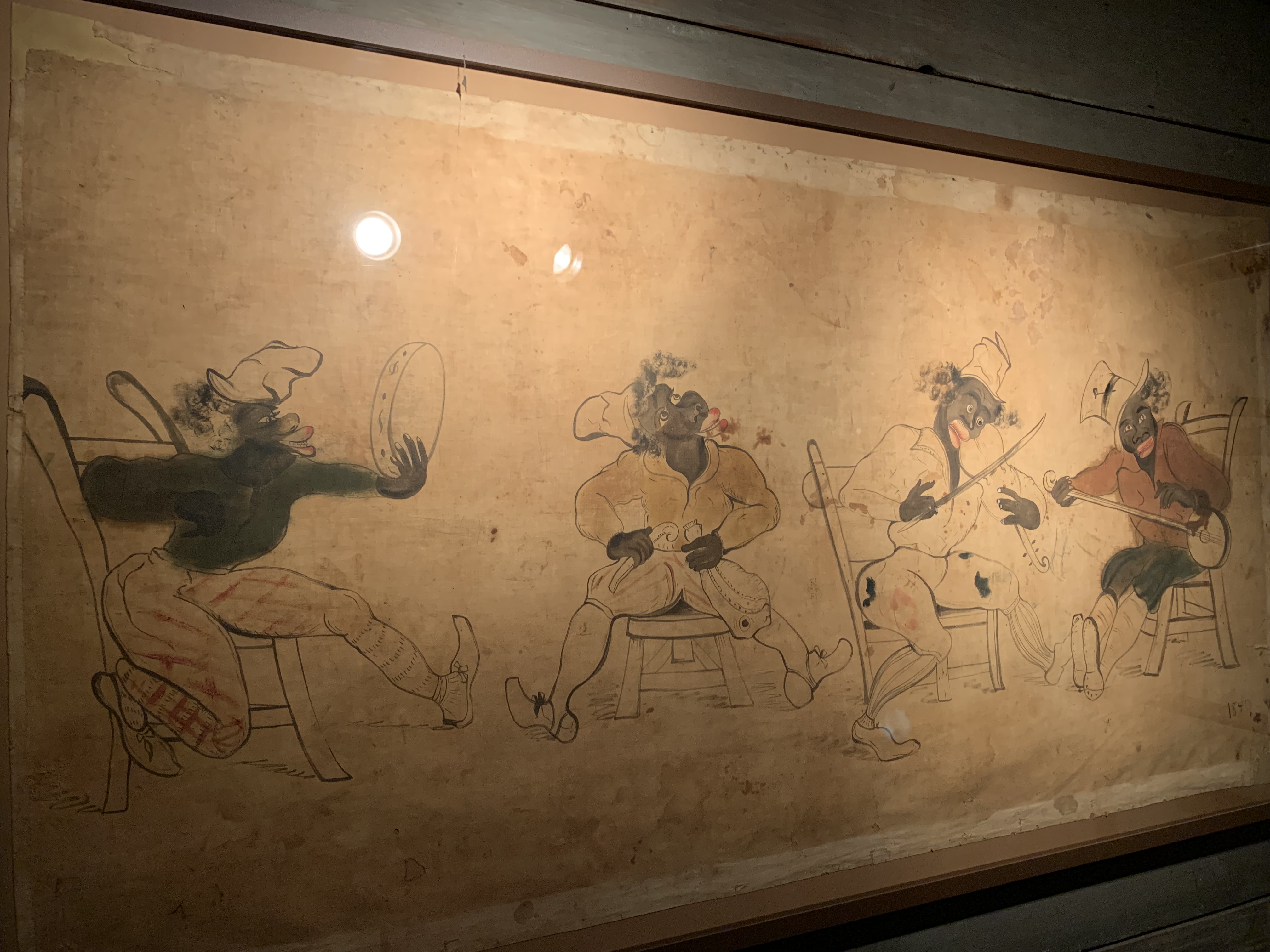
This tapestry is on display at the Medier Homestead Museum in Wappingers Falls, Dutchess County. This picture was painted depicting a minstrel show from the 1840’s. This tapestry was founded in the Wappingers Falls area in a chest. The banner shows figures similar to 1840s sheet music that can be found in the Library of Congress. The minstrel show is one of the earliest forms of American entertainment and it peaked after the Civil War and remained popular into the 1900s. These shows included the performances of black musicians who sang, with banjos, in the city streets.
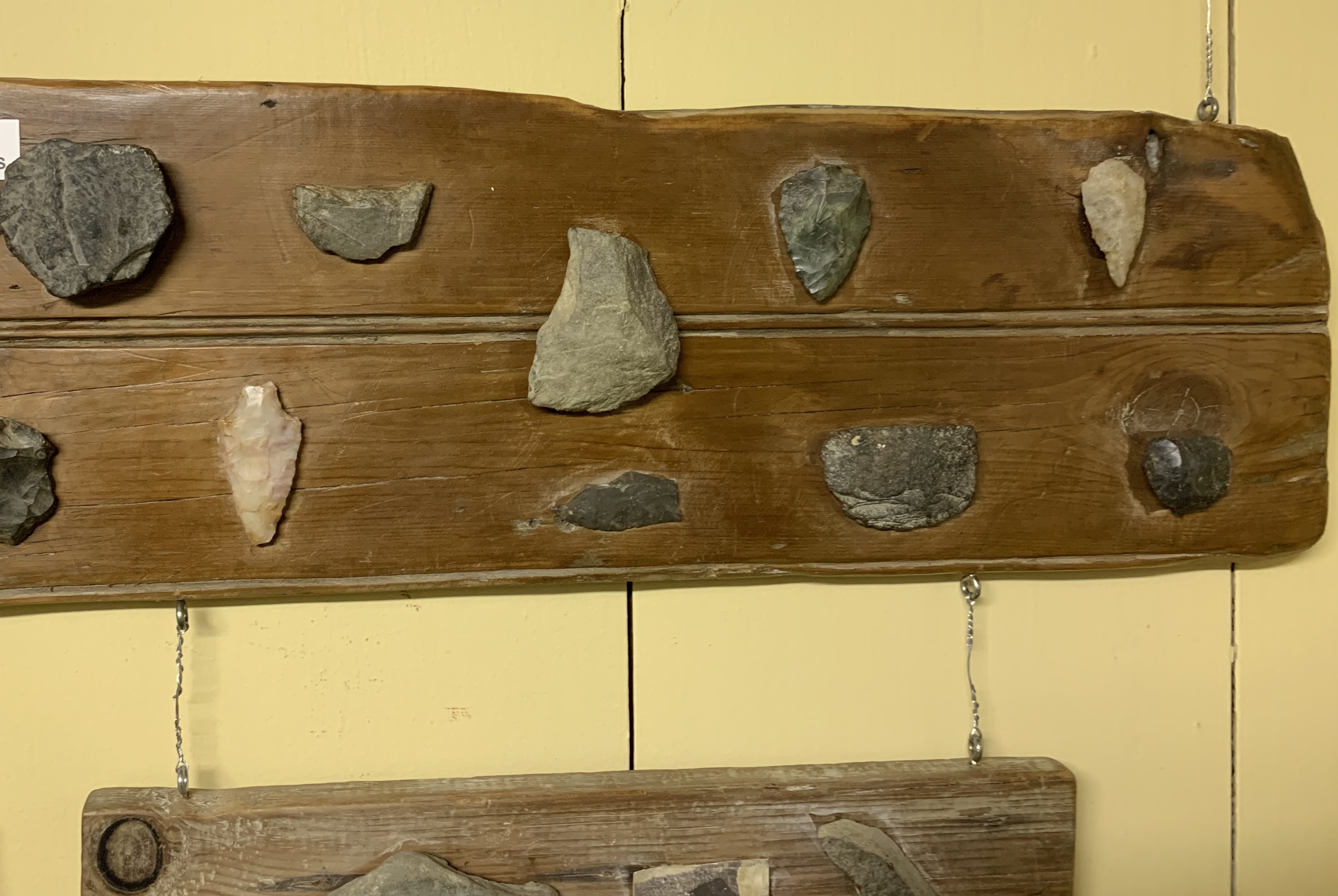
These ancient tools were on display at the Meiser Homestead museum in Wappingers Falls, Duchess County. Tools like these were used by early hominids to do thing like hunt and prepare food, as well as used to survive and fight if need be. These tools are usually sharpened to a point in order to be able to cut things easily. Tools like these would be equivalent to knifes in todays day and age. This source connects to the early human origins section of our class. These tools show that people living in these pre-colonial time periods were making tools that would evolve in modern times.
tools

A tool like this is called a Katanda Bone Harpoon point. People in central Africa would used pointed tools like this to spear huge prehistoric catfish weighing as much as 150 pounds. Humans also used tool like this to hunt other larger aquatic mammals. This tool was present during the Late Stone Age in Africa, which is how this source connects to our class. During this time period tools were made smaller and sharper. The lifestyle for people were aquatic, that is where a tool like this would work best, for hunting aquatic animals. The people during this time also did a lot more hunting than gathering.

